This is a guest post. Views are the author's own.
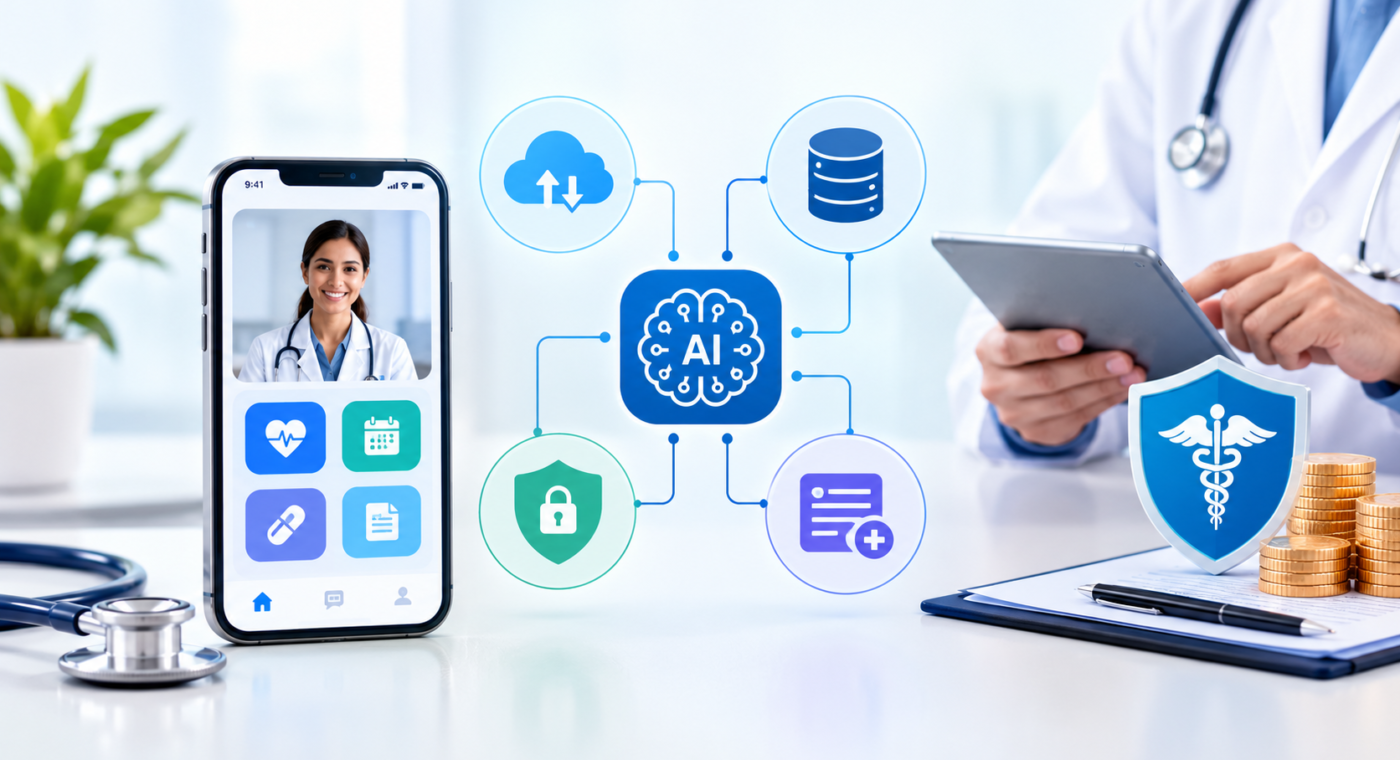
Healthcare organizations have moved past asking whether AI belongs in their software. The more useful question now is which problems it should solve, and what it takes to ship something safe, compliant, and affordable to run. AI-powered healthcare app development sits at the center of that question, covering patient-facing assistants, remote monitoring dashboards, scheduling and billing automation, documentation support, and risk scoring for care teams.
The model is rarely the hardest part. Projects stall on architecture, patient data privacy, regulatory scope, integration with existing records, and budgets that look reasonable at pilot stage and then double. This guide walks through each area in the order a project team will meet it, so founders, product managers, and CTOs can scope the work with fewer surprises.
What Is an AI-Powered Healthcare App?
An AI-powered healthcare app is software that uses machine learning, natural language processing, or generative models to support a task in a care or administrative workflow. The AI might read a patient’s free-text message and route it, flag a worrying trend in wearable data, draft a visit summary for a clinician to review, or predict which appointments are likely to be missed.
It helps to sort these tools by who they serve and what is at stake:
- Administrative AI handles scheduling, prior authorization paperwork, coding suggestions, and call-center triage. Patient safety risk is lower, though privacy rules still apply.
- Patient-facing AI includes symptom intake assistants, medication reminders, and coaching tools. These need careful wording, escalation paths, and clear limits on what the app will not do.
- Clinical decision support sits in front of clinicians and surfaces risk scores, suggested diagnoses, or imaging findings. This category draws the most regulatory attention.
Generative models have widened what is possible in all three, particularly for summarization and conversation. CMARIX has written about generative AI in clinical healthcare applications in more detail, and it pairs well with this guide if your use case leans toward documentation or decision support.
Key Features of an AI-Powered Healthcare App
Not every app needs every feature below. Pick the ones that match a real workflow problem, and be honest about their limits.
Symptom assessment and patient support. A guided intake flow can collect symptoms, history, and urgency signals before a visit, so clinicians start with better information. It supports triage; it does not replace a clinical assessment, and the app should say so plainly.
Virtual health assistants and chatbots. These answer routine questions, handle booking, and explain pre-visit instructions. The quality gap between a scripted bot and an LLM-based assistant is large, but so is the risk of confident wrong answers. Teams exploring this route can look at AI telemedicine chatbot development to see what a production setup involves, including guardrails and handoff to staff.
Remote patient monitoring. Data from wearables and home devices streams into a dashboard where models flag deviations from a patient’s baseline. The value is earlier attention for the right patients. The limitation is signal quality: consumer sensors are noisy, and alert fatigue will sink the feature if thresholds are poorly tuned.
Predictive analytics and risk identification. Models can estimate readmission risk, no-show probability, or deterioration likelihood. They are only as good as the data they were trained on, and they need validation on the population the app will actually serve.
EHR integration. An AI feature that lives outside the clinician’s existing workflow tends to go unused. Pulling context from the record and writing results back where staff already work is often what separates adoption from abandonment.
Appointment scheduling and workflow automation. Less glamorous, frequently the quickest return. Reminders, rescheduling, intake form pre-filling, and document routing remove repetitive work without touching clinical judgment.
Personalized patient engagement. Tailored reminders, education content, and follow-up nudges can improve adherence. Keep claims modest: engagement features support care plans, they do not guarantee outcomes.
How to Build an AI-Powered Healthcare App Step by Step
The healthcare app development process follows the usual product stages, with extra checkpoints for data, safety, and regulation.
1. Define users and objectives. Name the primary user (patient, nurse, physician, billing staff) and the measurable result you want, such as fewer missed appointments or shorter documentation time. A vague goal like ‘add AI’ produces a vague product.
2. Identify suitable AI use cases. Ask whether the problem needs AI at all. Rules or simple automation solve more problems than teams expect. Where AI does fit, match the technique to the task: classification for triage, forecasting for risk, and language models for summarization.
3. Research workflows and regulations. Shadow real clinical or administrative workflows, and map which regulations apply based on who you serve, where, and what the software claims to do. This step shapes the budget more than most teams expect.
4. Select the technology stack and AI approach. Decide between a pretrained model accessed through an API, a fine-tuned model, or a custom-trained one. Data sensitivity often decides this: sending identifiable patient data to an external model requires contractual and technical safeguards.
5. Design the user experience. Clinicians have seconds, not minutes. Show why the AI suggested something, make it easy to override, and design empty and error states carefully.
6. Develop and integrate. Build the application layers, connect to EHR and other systems, and wire in logging from day one. Many teams work with a partner offering AI application development services at this stage to avoid rebuilding the data pipeline later.
7. Test security, usability, reliability, and model performance. Penetration testing, usability sessions with real staff, load testing, and model evaluation on representative data all belong here. Test failure behavior too: what happens when the model is unavailable or uncertain?
8. Deploy, monitor, and maintain. Launch with a limited cohort, watch both system health and model quality, and schedule regular reviews. Models drift as patient populations, coding practices, and workflows change.
Understanding AI Healthcare App Architecture
Healthcare app architecture is easiest to reason about as layers, each with a clear job and a clear boundary.
Frontend and User Experience Layer
This covers the patient mobile app, clinician web dashboard, and any admin console. Beyond screens, it handles session timeouts, biometric or multi-factor login, and accessibility. Keep sensitive data off the device where you can, and avoid caching identifiable records in local storage.
Backend and API Layer
The backend enforces business rules, orchestrates calls to the AI layer, and exposes APIs to the frontend. An API gateway centralizes authentication, rate limiting, and request logging. Separating the AI services behind internal APIs lets you swap or update models without touching client apps.
AI and Machine Learning Layer
This is where model serving, feature pipelines, and evaluation live. Models run as versioned services so that every prediction can be traced to a specific model release. For generative features, a retrieval step that grounds answers in approved clinical or policy content reduces fabricated responses, and output filters catch unsafe content before it reaches a user.
Healthcare Data and Database Layer
Identifiable records, de-identified analytics data, and model training sets should not sit in one undifferentiated store. Separate them, apply field-level access rules, and keep a clear lineage of which data trained which model.
EHR/EMR and Third-Party Integrations
Hospitals typically expose data through HL7 v2 messages, FHIR APIs, or vendor-specific interfaces, and many projects meet all three. An integration engine or adapter layer keeps this complexity away from the core application. Expect each EHR connection to need its own testing and, often, its own approval process.
Security, Monitoring, and Audit Layer
Cross-cutting controls sit here: encryption in transit and at rest, key management, role-based access, and immutable audit logs recording who accessed what and when. Monitoring should cover both infrastructure and model behavior, such as sudden shifts in output patterns.
Choosing the Right AI Technology Stack
There is no standard stack, only trade-offs. The table below lists common options and what should drive the choice.
| Area | Common options | What should decide it |
|---|---|---|
| Mobile and web | React Native, Flutter, native iOS/Android, React, or Angular | Device features needed, team skills, offline requirements |
| Backend and APIs | Node.js, Python (FastAPI, Django), Java, .NET | Existing systems, AI library support, throughput |
| Cloud and storage | AWS, Azure, and Google Cloud with managed databases | Willingness to sign a business associate agreement, regional data rules, cost |
| ML and serving | PyTorch, TensorFlow, scikit-learn, and managed ML platforms | Model type, latency needs, team experience |
| Generative AI | Hosted LLMs, open-weight models self-hosted | Data sensitivity, cost per request, need for fine-tuning |
| Interoperability | HL7 v2, FHIR, SMART on FHIR | What the connected health systems actually support |
HL7 FHIR has become the common language for modern health data exchange, so designing around it early reduces rework. Choosing a cloud provider that offers compliance-supporting services is helpful, but no provider choice makes an application compliant by itself.
Healthcare Compliance, Privacy, and Data Security
Which rules apply depends on your organization’s role, the jurisdictions involved, the data you process, and the intended use of the software. The notes below are general information, not legal advice, so involve counsel early.
HIPAA Requirements for Applicable US Healthcare Applications
HIPAA applies to covered entities (most providers, health plans, clearinghouses) and to business associates that handle protected health information on their behalf. HHS guidance on health apps shows the distinction clearly: a consumer app where people enter their own data, with no covered entity involved, generally falls outside HIPAA, while an app built for a provider to manage patient messaging or monitoring generally falls inside it. If you are a business associate, you will need business associate agreements and safeguards under the Security Rule. For a practical walkthrough, see CMARIX’s guide to building a HIPAA-compliant mobile application. Apps outside HIPAA are not free of obligations; consumer protection and breach notification rules from other regulators can still apply.
GDPR and Other Applicable Privacy Regulations
When you process personal data of people in the EU or UK, GDPR treats health data as a special category with stricter conditions for processing. That usually means a clear lawful basis, data minimization, purpose limits, and a data protection impact assessment for higher-risk processing. Other regions and several US states have their own health data and AI rules, so a multi-market launch needs a jurisdiction map before design is final.
Data Encryption, Access Controls, and Audit Trails
These are security practices that regulations expect, not compliance in themselves. Encrypt data in transit and at rest, apply least-privilege access, require strong authentication, and log access in a tamper-evident way. Plan for incident response and breach notification before launch, not after.
AI Model Validation, Explainability, and Human Oversight
In the US, the FDA updated its guidance on clinical decision support software and on general wellness products in January 2026, superseding the 2022 and 2019 versions. In broad terms, software intended to diagnose or treat can qualify as a regulated medical device, clinician-facing decision support may fall outside that definition only if specific criteria are met, and low-risk wellness tools are treated differently again. The line depends on your stated intended use, so write marketing claims and product behavior with that in mind. In the EU, AI inside regulated medical devices is classed as high-risk under the AI Act, with obligations that, under the 2026 Digital Omnibus agreement, are due to apply from August 2028 for such systems, so confirm the final adopted dates with your regulatory adviser. Whatever the jurisdiction, generative AI should not independently diagnose or treat patients without appropriate validation, oversight, and regulatory consideration.
Secure Data Storage and Third-Party Vendor Management
Every vendor that touches patient data, including cloud hosts, analytics tools, and model API providers, is part of your risk surface. Sign the necessary agreements, confirm where data is stored and whether it is retained or used for training, and review vendors on a schedule.
How Much Does AI Healthcare App Development Cost?
Cost depends on scope far more than on any single technology choice. Design, backend, AI work, security, testing, integrations, and infrastructure all contribute, and EHR integration and compliance work are the lines that surprise people most. For a broader view, CMARIX has a dedicated breakdown of healthcare app development cost, and a video-visit layer adds its own items, covered in the telemedicine app development cost guide.
The ranges below are indicative figures pulled from published vendor estimates, not benchmarks or quotations.
| Scope | What it typically includes | Indicative range (USD) | Typical timeline |
|---|---|---|---|
| Basic MVP | One AI use case, such as intake chat or scheduling automation, one platform, minimal integrations | 40,000 to 120,000 | 3 to 6 months |
| Moderate application | Several AI features, one EHR integration, role-based dashboards, security testing | 120,000 to 300,000 | 6 to 9 months |
| Advanced platform | Clinical decision support or imaging AI, multiple EHR integrations, validation work, regulatory preparation | 300,000 to 1,000,000+ | 12 to 24 months |
These figures assume a blended team rate, a single-region build, and a defined scope. They exclude legal fees, clinical studies, and any regulatory submission costs. Treat them as a starting point for discovery, then replace them with a scoped estimate.
The launch budget is only part of the picture. Healthcare app maintenance cost is commonly estimated at 15 to 25 percent of the initial build per year, so a 200,000 dollar project may need 30,000 to 50,000 dollars annually for fixes, security patches, and compliance updates. AI adds recurring items on top: inference charges per request, cloud compute, monitoring, retraining, and periodic revalidation. A proposal with no maintenance line only looks cheaper.
Common Challenges in AI Healthcare App Development
Sensitive and fragmented data. Patient data is spread across systems in inconsistent formats. Start with a data audit and normalize through FHIR mappings where possible, rather than assuming clean inputs.
Legacy system integration. Older systems may offer limited or undocumented interfaces. Budget extra time for discovery and use an adapter layer so legacy quirks stay contained.
Accuracy and hallucinations. Language models can produce fluent, incorrect statements. Ground outputs in approved sources, restrict the assistant’s scope, and route uncertain cases to humans.
Patient and clinician trust. People abandon tools they cannot understand. Explain what the AI does, show its confidence where appropriate, and make human contact easy to reach.
Regulatory change. Rules on AI and medical software are moving. Keep compliance requirements in the backlog, and review them at least quarterly.
Scalability and upkeep. Pilot traffic hides cost and latency problems. Load-test early, and set cost alerts on inference usage.
Best Practices for Building a Reliable AI Healthcare App
A few habits separate dependable products from fragile ones. Start with one narrowly defined use case and prove it before expanding. Design privacy in from the start, collecting only the data a feature needs. Train and test on data that reflects the real patient population, and document its limits. Define quality metrics for the model, monitor them after launch, and decide in advance what triggers a rollback. Keep a human in the loop wherever an error could affect care or billing. Finally, schedule maintenance and model reviews as part of the roadmap, not as an afterthought.
Conclusion
Successful AI-powered healthcare app development comes down to four things done in the right order: a well-defined problem, a layered architecture that keeps data and models under control, a clear view of which regulations apply, and a budget that includes the years after launch. The apps that last are the ones that solve a real workflow problem, not the ones that add AI features for their own sake.
If you are weighing a build and want a second opinion on scope or architecture, explore CMARIX’s AI product development services to see how a team approaches the path from idea to production.