

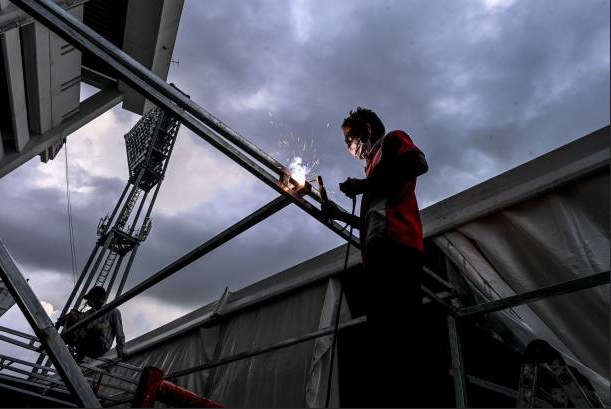
Outdoor welded structures rarely fail all at once. A railing, platform, gate, stair system, or support frame may look stable from a distance, while moisture, vibration, corrosion, poor drainage, and repeated temperature changes are already weakening the welded connections.
In busy outdoor commercial environments, these structures also face constant use, impacts, cleaning chemicals, and weather exposure. When fabrication details, material selection, coatings, or maintenance are overlooked, even strong welds can lose performance sooner than expected.
Understanding why welded structures fail prematurely helps property owners, contractors, and facility managers spot risks earlier and make better repair decisions.
To see where problems usually begin, let’s look at the most common outdoor conditions that place stress on welded commercial structures.
Key Takeaways
- Moisture and contaminants can accelerate corrosion around welded joints.
- Repeated loading and temperature changes may cause fatigue cracks.
- Poor joint geometry can concentrate stress in vulnerable areas.
- Porosity, lack of fusion, and hydrogen cracking can reduce joint integrity.
- Regular inspections can identify damage before major failure occurs.
Corrosion Around Welded Connections in Outdoor Commercial Environments
Galvanic Action Between Dissimilar Metals
Galvanic action occurs when different metals remain in contact in the presence of an electrolyte, such as rainwater or condensation. The less corrosion-resistant metal deteriorates faster, causing concentrated material loss near the connection.
This issue can develop when carbon steel, stainless steel, aluminum, galvanized components, or incompatible fasteners are combined without proper separation. As the affected material becomes thinner, the joint may lose stability and require early repair.
Material compatibility should be considered during structural planning, architectural fabrication, and repair work. Suitable filler metals, fasteners, coatings, and isolation materials can help prevent accelerated corrosion.
Crevice and Pitting Corrosion
Small gaps, overlapping plates, irregular weld profiles, and poorly sealed joints can hold water and contaminants. Because these areas dry slowly, they create favorable conditions for crevice corrosion and pitting.
Pitting forms narrow cavities that penetrate the surface and weaken isolated sections of metal. Corrosion can also spread beneath damaged coatings, leading to blistering, peeling, and broader surface deterioration.
These problems commonly develop around base plates, railing connections, support brackets, and enclosed joints in outdoor commercial environments, particularly where water cannot drain freely.
Sensitization in Stainless Steel
Stainless steel depends on chromium to create a corrosion-resistant surface layer. Excessive welding temperatures can cause chromium to combine with carbon along the grain boundaries.
This process, known as sensitization, leaves the heat-affected region more vulnerable to intergranular corrosion. The risk is greater in coastal, industrial, or chemically exposed locations.
Suitable stainless-steel grades, compatible filler materials, and carefully managed welding parameters can help preserve the protective properties of the metal.
Fatigue from Weather, Movement, and Daily Use
A welded structure does not need to experience one severe overload to become damaged. In outdoor commercial environments, daily use, shifting loads, and seasonal movement can gradually weaken critical connections.
Wind and Thermal Loads
Wind places changing pressure on exterior structures, while daily temperature shifts make metal expand and contract. These alternating conditions create tension and compression within welded connections.
Minor surface irregularities may become starting points for fatigue damage. Continued stress can extend the crack until the connection no longer performs reliably.
Large frames, elevated platforms, signs, gates, stairs, and long railing systems are particularly vulnerable when expansion has not been accommodated during design. Joint placement, support spacing, and fabrication methods should therefore match the structure’s expected operating conditions.
Residual Stress from Uneven Cooling
Welding heats a concentrated section of metal and causes it to expand. During cooling, different parts contract at different speeds, leaving locked-in forces within the weld and nearby base material.
These forces can make the connection more vulnerable to impact, added weight, and later temperature movement.
Experienced providers of custom welding manage welding sequence, fit-up, heat input, and cooling practices to control distortion and limit unwanted stress.
Geometrical Stress Risers
Loads do not always pass smoothly through a welded structure. Sharp corners, abrupt thickness changes, undercutting, rough weld profiles, and excessive weld buildup can direct force into small, concentrated areas.
These features increase localized strain around notches, holes, corners, and transitions between components, making fatigue damage more likely.
Well-designed joints, gradual transitions, and proper weld finishing allow forces to travel more evenly through the assembly.
Welding Defects That Reduce Joint Strength
Internal welding defects can interfere with the transfer of force between connected components. Poor surface cleaning, uncontrolled jobsite conditions, incorrect equipment settings, or improper welding techniques can increase this risk during on-site work in outdoor commercial environments.
Porosity and Trapped Gas
Porosity develops when gas becomes trapped inside molten weld metal as it solidifies. During outdoor welding, wind can interfere with the shielding gas that protects the weld pool.
Incorrect gas flow, rust, oil, dirt, and unfavorable site conditions may also contribute. The resulting voids interrupt the continuity of the weld and limit how effectively it carries service loads.
Professional welding services may use wind barriers, stable shielding gas coverage, properly cleaned base metal, and suitable field procedures to prevent gas pockets from forming.
Lack of Fusion
Lack of fusion occurs when the filler metal does not bond fully with the base metal or an earlier weld pass. Common causes include low heat input, poor electrode positioning, excessive travel speed, and an unsuitable joint setup.
The unbonded area creates a weak plane that may begin to separate as force transfers between the connected components. This defect is especially serious in platforms, frames, structural supports, and safety barriers.
Critical applications may require additional inspection methods to verify that complete fusion has been achieved.
Hydrogen Cracking
Hydrogen cracking develops when hydrogen enters the weld through damp electrodes, condensation, wet base metal, or improper material storage.
As the joint cools, hydrogen can accumulate in highly stressed areas and create fine fractures. These cracks may appear several hours or days after the welding work has been completed.
Keeping materials dry, storing electrodes correctly, applying the required preheat, controlling interpass temperatures, and cleaning the joint can help limit this delayed form of damage. When cracking affects machinery frames, equipment supports, or welded attachments, professional equipment repair may be necessary to restore structural reliability.
Conclusion
Premature weld failure is rarely caused by a single issue. Corrosion, cyclic loading, residual stress, unsuitable materials, and fabrication flaws often combine until a connection can no longer perform safely. In outdoor commercial environments, early inspections and timely repairs are essential because weather, contaminants, and daily use continue affecting the structure throughout its service life.
Choosing compatible metals, following controlled welding procedures, improving drainage, and maintaining protective coatings can extend structural service life. When damage appears, the best solution is to correct the underlying cause rather than repeatedly patching a visible crack or rusted area without first evaluating the entire connection.
FAQs
What are the first signs of weld failure outdoors?
Early warning signs may include rust staining, cracked coatings, surface pitting, loose connections, visible fractures, deformation, or unexpected movement around the joint.
Can outdoor corrosion affect a weld beneath its coating?
Yes. Moisture can enter through small coating defects and spread underneath the surface, weakening the weld area before extensive rust becomes visible.
Why do repaired weld cracks sometimes return?
Cracks may return when the repair covers the visible damage without correcting the underlying cause, such as fatigue, poor joint geometry, corrosion, or excessive stress.
Are stainless-steel welds completely resistant to corrosion?
No. Stainless steel can still corrode when the wrong grade or filler material is used, welding heat is poorly controlled, or the surface is exposed to aggressive contaminants.
How often should outdoor welded structures be inspected?
Inspection frequency depends on the structure’s use, location, loading, and exposure. Safety-related, coastal, industrial, or heavily used structures may need more frequent professional assessments.