
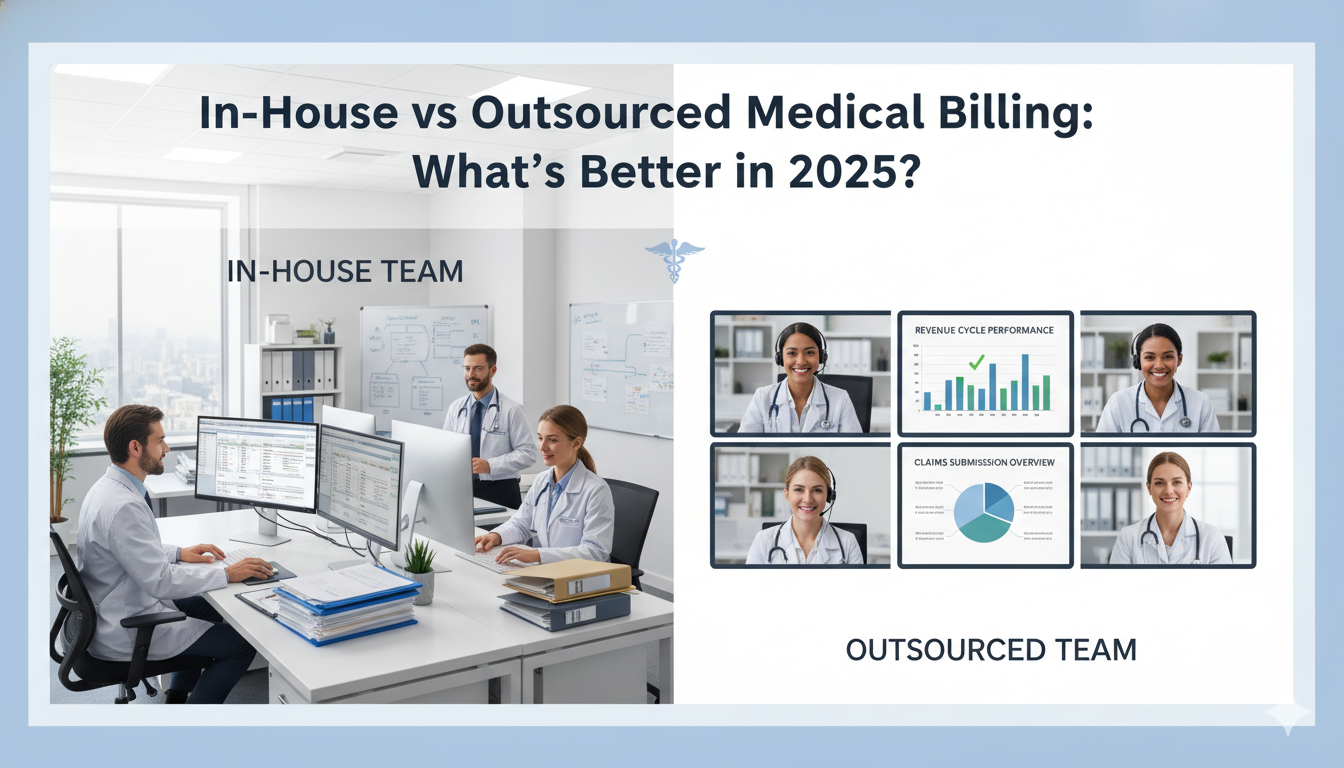
Medical billing continues to change quickly as healthcare organizations manage rising costs, staff shortages and stricter insurance requirements. As clinics look for ways to improve accuracy and protect their revenue, many providers are asking whether in-house billing is still practical or if it is time to switch to outsourced billing support. This guide explains the differences between both models and helps you understand whether in-house or outsourced medical billing is the better choice in 2025.
Understanding How Medical Billing Works in 2025
The Purpose of Revenue Cycle Management
Revenue Cycle Management plays a major role in the financial health of every practice. It covers everything from patient registration to claim submission and payment collections. As insurance rules become more complex, clinics must rely on accurate coding, clean claims and strong follow up to get paid on time.
The Two Most Common Billing Models
Healthcare organizations usually choose between two options. They can hire and manage their own in-house billing staff or work with professional outsourced RCM services. Both options can be effective, but each one has very different costs and responsibilities.
In-House Medical Billing Pros and Cons
Advantages of In-House Billing
Keeping billing operations in-house gives clinics full control over every step of the process. Communication between billing staff and clinical teams is easy and immediate since everyone works in the same location. In-house teams can also customize their workflow to match the specific needs of a specialty.
Disadvantages of In-House Billing
The biggest drawback is the cost. Hiring trained billers, paying salaries, covering benefits and keeping staff updated with ongoing training can be expensive. Practices must also pay for software, technology updates and compliance tools. If a biller leaves, the clinic must replace and retrain someone, which creates delays and increases the risk of unpaid claims.
When In-House Billing Makes Sense
Larger practices with stable staff and strong financial systems often prefer in-house billing. They have the resources to manage detailed workflows and maintain tight control over their revenue cycle.
Outsourced RCM Services: A Growing Trend in 2025
What Outsourced Medical Billing Includes
Outsourced RCM services handle many important tasks. They submit claims, follow up on unpaid accounts, manage denials, review coding and provide performance reports. This allows providers to focus on patient care while a dedicated team manages revenue collection.
Outsourced Medical Billing Benefits
Outsourcing reduces overhead because clinics do not need to hire, train or supervise billing staff. Providers gain access to certified billing specialists who stay updated with insurance rules. Claims are usually submitted faster and more accurately, which improves cash flow. Outsourcing also removes a large administrative burden from the clinical team.
Pros and Cons of Outsourced Billing
Pros:
-
Reduced administrative workload
-
Lower long term costs
-
Improved accuracy and fewer claim errors
-
Access to specialized billing teams
-
Stronger A R follow up
Cons:
-
Less direct control over daily billing tasks
-
Need for clear communication with the vendor
-
Dependence on a third party’s timeline
Why Outsourcing Medical Billing Is Increasing in 2025
Many practices are choosing outsourcing due to rising staffing costs and difficulty finding qualified billers. Insurance companies continue to tighten claim rules, which increases the need for expert oversight. Outsourcing helps clinics stay compliant while increasing reimbursement.
In-House vs Outsourced Medical Billing: A Side-by-Side Comparison
Cost Comparison
In-house billing includes salaries, benefits, software costs, training and hardware. Outsourced billing replaces these costs with a predictable service fee. For many practices, outsourcing becomes more cost efficient over time.
Accuracy and Claim Success Rates
Outsourced billing companies usually maintain higher clean claim rates because they employ teams of specialists. In-house accuracy depends on the skill level of a small number of staff members. This can make a significant difference in monthly collections.
Compliance and Security
Both models must meet HIPAA requirements. Outsourced RCM services often have dedicated compliance officers and strict data protection protocols. In-house departments must manage compliance internally, which can be challenging without proper training.
Workflow Efficiency
Outsourced teams can process claims quickly and consistently, even during staff shortages or busy seasons. In-house teams may experience delays if staff members are out of office or overloaded with tasks.
Choosing the Right Billing Model for 2025
Key Questions Providers Should Ask
-
Are our claims being paid on time
-
How much are we spending on billing staff
-
Do we have the technology needed to stay compliant
-
Is our denial rate increasing
-
Are administrative tasks affecting patient care
When Outsourcing Is the Better Option
Outsourcing works well for small and mid-sized practices that struggle with staffing or want predictable monthly costs. It also helps clinics that need stronger accuracy and faster claim submissions.
When In-House Billing May Still Be Ideal
Practices with established billing departments and strong financial infrastructure may prefer to keep their billing operations internal. They value full control and already have the resources to support their workflow.
Final Verdict: What’s Better in 2025
Both models have strengths, but the best choice depends on the goals of the practice. Outsourced RCM services offer cost savings, higher accuracy and reduced administrative stress, which is why many clinics are moving in that direction in 2025. Larger organizations or specialty practices with stable teams may still benefit from in-house billing. Understanding your clinic’s needs, staffing capacity and financial goals will help you choose the billing model that keeps your revenue cycle healthy and efficient.